

Residential | Master Planning | Competition
Kharkiv Housing
From dormitories to communities: A Manifesto for War Resilient Housing
Saltivka.
The dormitory town of Kharkiv, Ukraine.
The primary victim of Russia’s warmongering in the recent past.
Scars of war drive deep into the foundation of any society that has been displaced and forced to survive in extreme conditions, like the people of Saltivka were, post the horrors of February 24, 2022. It lingers as a shameful reminder of human insanity that creates inhuman conditions and irrational catastrophe. This competition allows us to explore “community housing in the times of war and peace”. The destroyed housing blocks at Saltivka give us an opportunity to introspect on the nature of the housing community that existed on the site. It opens up multiple scenarios to strengthen the devastated community that has been targeted by the recent war destruction. The current habitat of Saltivka could be viewed as social housing without a social milieu that binds a community together. Our design proposal focuses on the revival of social interaction across various scales of revitalization, attempting to imbibe a rejuvenated sense of communal harmony.
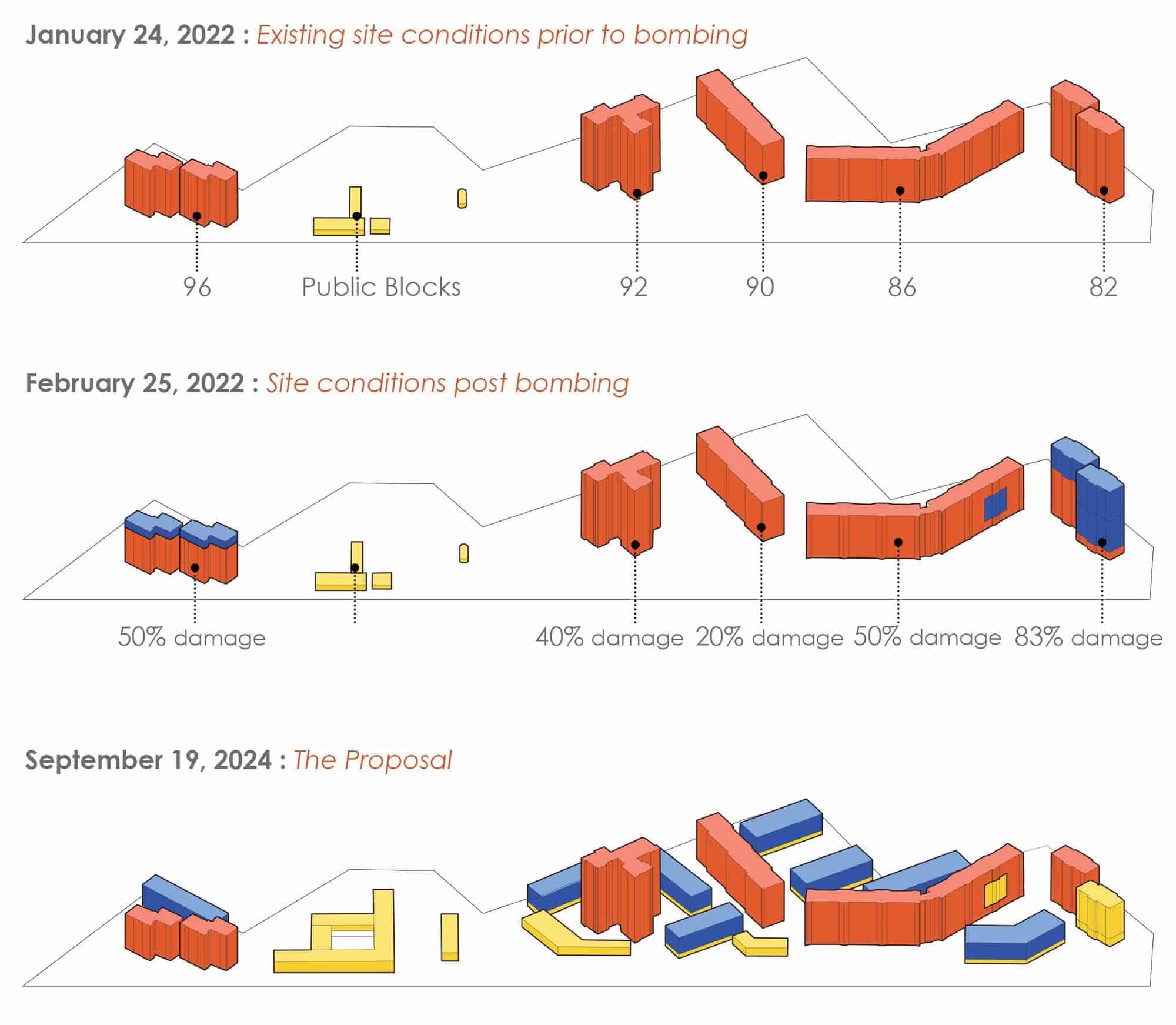
January 24, 2022 : Existing site conditions prior to bombing
Buildings as islands : The housing blocks, that exist on site (unscathed prior the attack), were built in the 1980s.
They are experienced as towers without a reference to the ground level and in turn, exhibit a disconnected relationship with its adjacent towers (block). The built and open public spaces are scattered all over site in a detached formation.
February 25, 2022 : Site conditions post bombing
The Devastation : Various levels of damage were imparted on each building giving rise to different possibilities of retrofitting and/or re-erecting in order to revitalize them collectively with the public spaces.
September 19, 2024: The Proposal
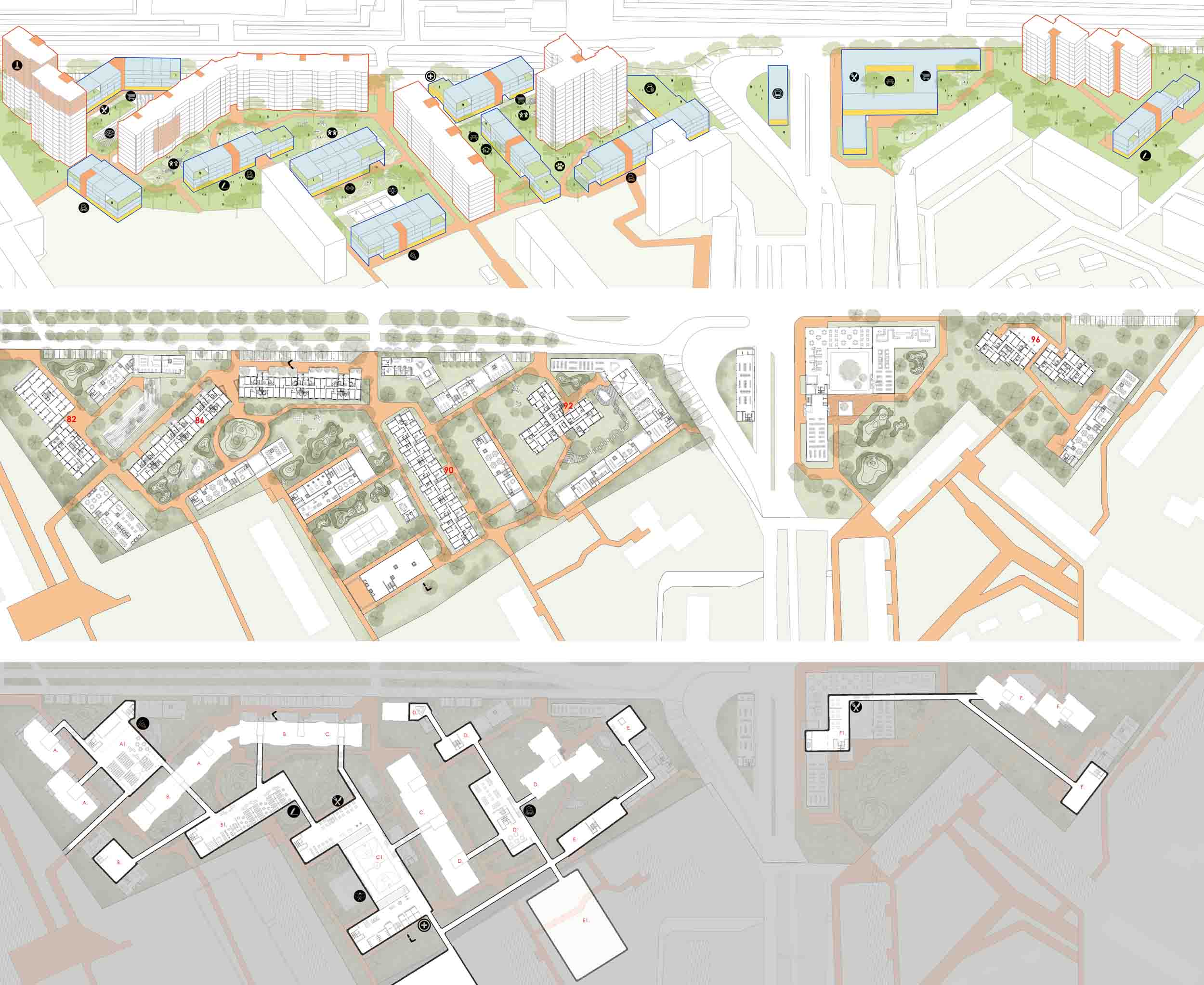
Buildings as constellations: Our design focuses on creating a tightly knit constellation that allows for new social relations to be formed both at the ground level and the basement level. Newly scaled building blocks are placed in conjunction with the existing towers to form enclosures that create a sense of security and a haven for children and the elderly. The spaces between buildings are reimagined with human-scaled elements in cohesion with a natural landscape, thus fostering a sense of community.
Creating neighbourhoods:
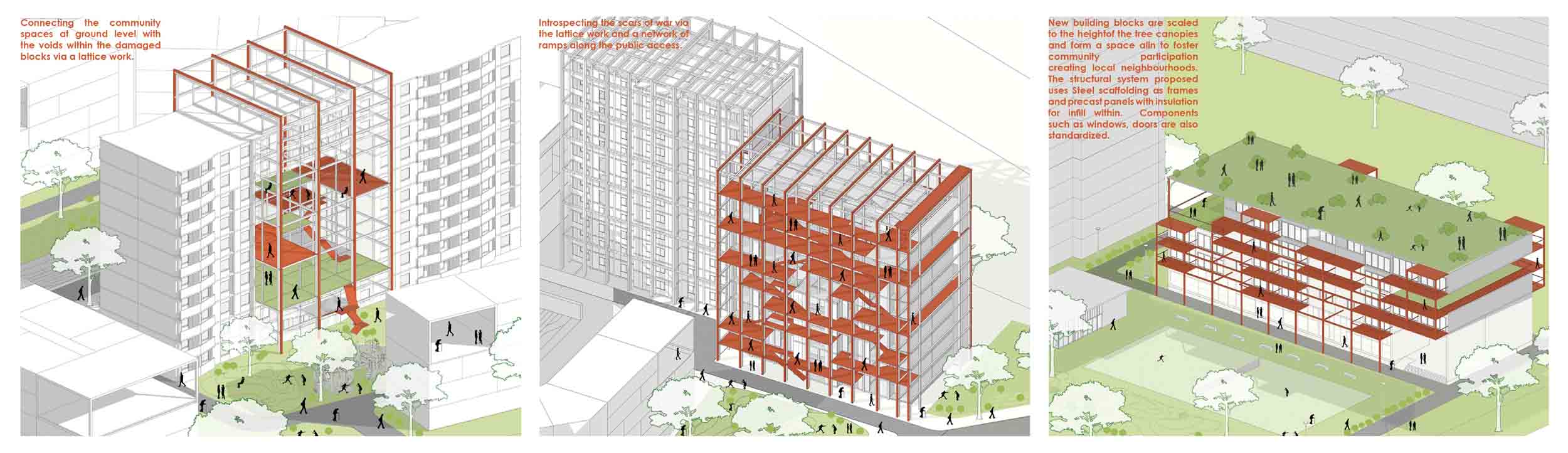
By increasing the ground cover, we envision building a stronger relationship with the open landscape and its active use by the resident community. New building blocks are scaled to the height of the tree canopies and form a space akin to fostering community participation. These open spaces are dedicated to pedestrian activity and act as congregation bubbles for all age groups. The open spaces are well connected by creating voids at the lower levels of the building, in the new proposed buildings as well as the old existing residential blocks, giving rise to a porous groundscape.
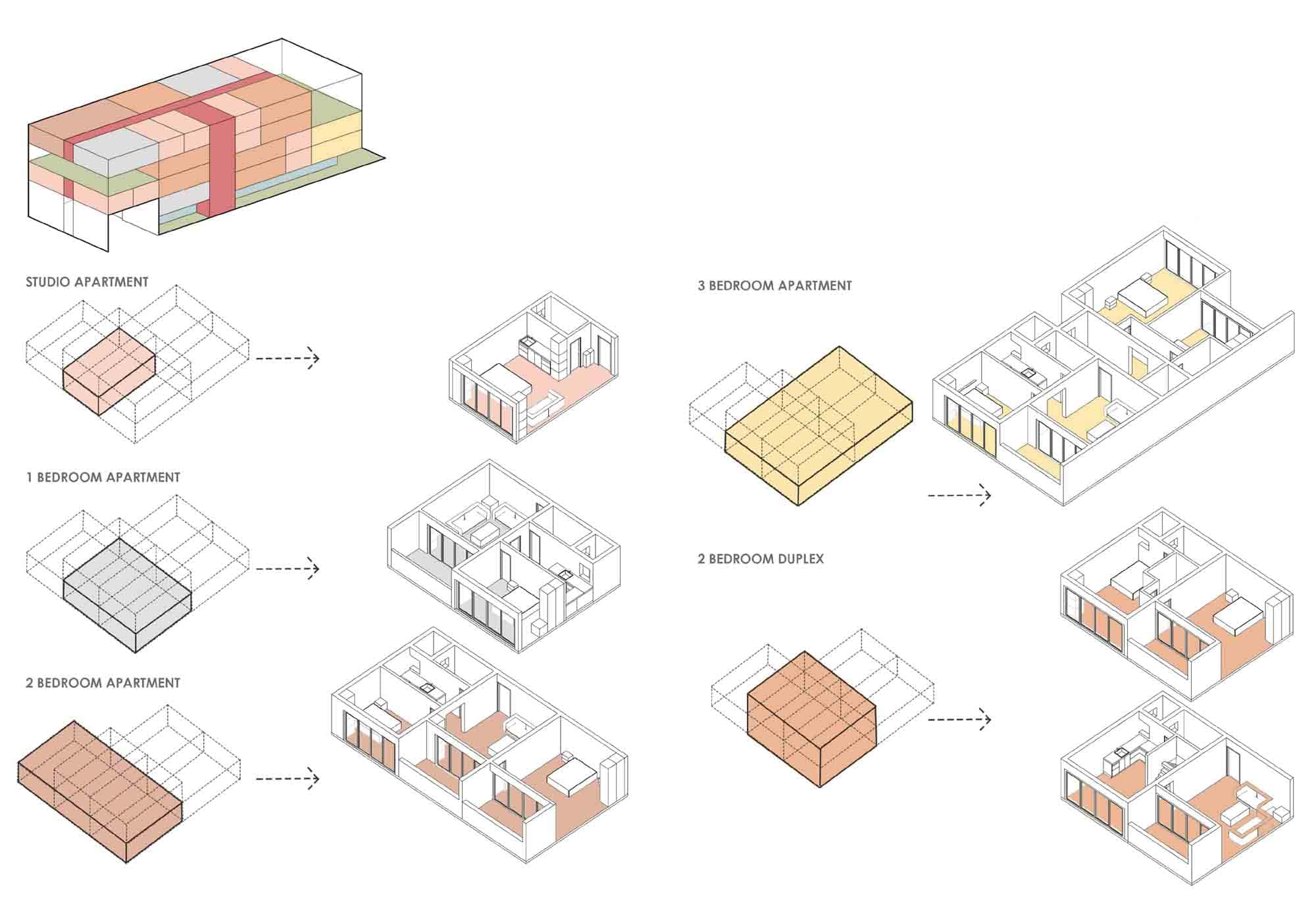
Re-erected module proposal :
Units, following a multipliable grid, are designed to suit individuals who can share accommodation as well as families of varying sizes. These unit modules are aggregated to form a diverse mix, allowing for better inclusivity of a vast diversity of individuals and families. The varying sizes of modular units and their diverse configuration of the module within a block create endless possibilities to accommodate the residents’ needs. This, combined with a dedicated public/ semi-public area on the ground floor, allows for the formation of multisized, vibrant neighbourhoods.
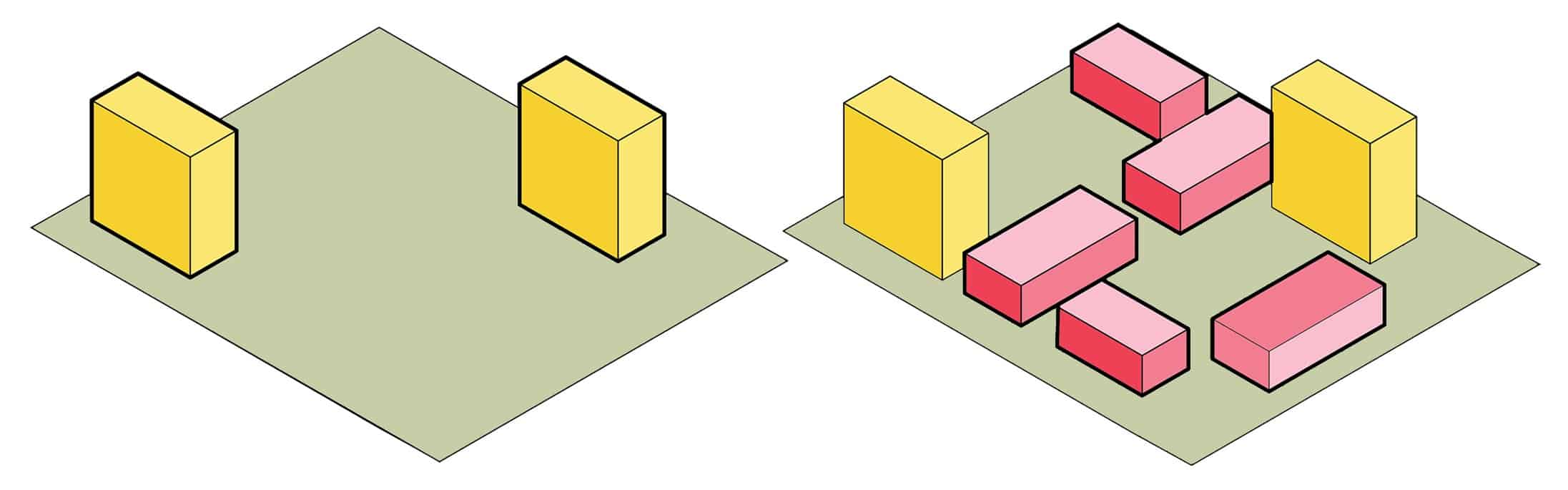
Building as Island v/s Building constellation:
The current housing blocks are experienced as towers without a reference to the ground level and a disconnected relationship with its adjacent towers (block). Our design focuses on creating a tightly knit constellation that allows for new social relations to be formed both at the ground level and the basement level.
Design Attitude to community spaces:
New scaled building blocks are placed in conjunction with the existing towers to form enclosures which create a sense of security and a safe haven for children and the elderly.
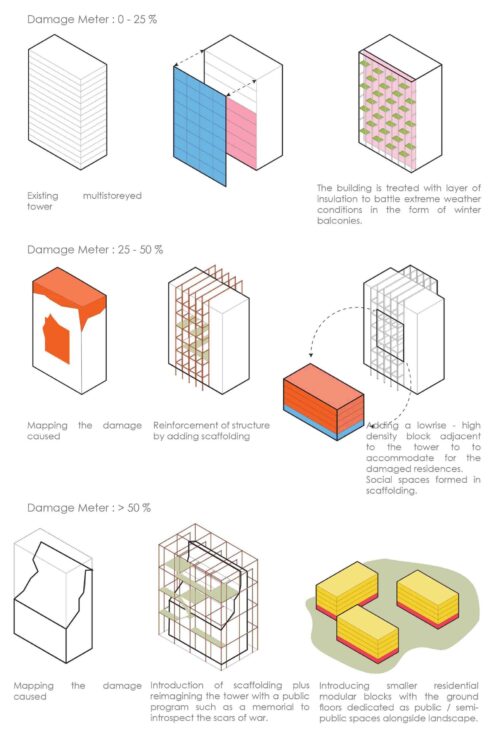
Natural landscapes foster a sense of community. The tower affected by air strikes is envisioned as a neighborhood level community program within the voids of the building. These voids overlook the larger open spaces at the ground level and set up a hierarchy of open spaces that tie the community together.
A network of bomb shelters
Underground connections are created by increasing the possibility of escape routes and interconnectedness from the basements of buildings to seamlessly network the bomb shelters. The new bomb shelters are programmed as social spaces, cultural spaces, spaces for learning, sporting and recreation spaces. The diverse programs ensure the inclusiveness of the large resident community and their interests. The underground environmental conditions also provide for insulation during the harsh winter months and bring down the annual energy cost by 35 percent.
The voids are structurally envisioned as a lattice work on the outside to support the destroyed void. The structural system is rendered as a modular three-dimensional grid to allow for a flexible arrangement of programmed platforms within the void. The void and the latticework allow for visually communicating floor plates with transparent stairs to make physical connections to enhance the interactions and engaging experience within the space. Additional diverse community programs to strengthen the social milieu of housing.
Gallery


